


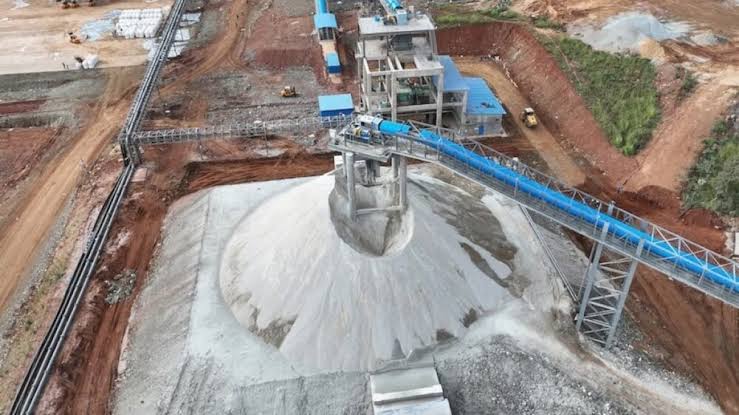

Zimbabwe continues to lose billions of dollars in potential revenue by exporting raw, unprocessed minerals despite aggressive government policies aimed at forcing local value addition, the Minerals Marketing Corporation of Zimbabwe (MMCZ) revealed.
According to recent disclosures from the state-run marketing body tasked with overseeing the country’s mineral wealth, a massive financial deficit persists because foreign buyers are capturing the bulk of the value chain.
MMCZ General Manager Dr Nomusa Jane Moyo recently exposed the stark reality of this value gap by highlighting the country’s booming lithium sector, noting that raw lithium ore fetches a mere $50 per tonne on the international market, whereas battery-grade processed lithium commands up to $22,000 per tonne.
This staggering price differential represents wealth directly exported to foreign economies that possess the advanced refining infrastructure Zimbabwe is still rushing to construct, a problem compounded by the fact that the nation loses up to $15 billion annually to illicit financial flows, mineral smuggling, and the illegal cross-border movement of unbeneficiated ore.
This multi-billion-dollar deficit is the latest chapter in a long-standing historical struggle to control the country’s vast natural resources.
For decades, dating back to the colonial era and continuing through the late 20th century, Zimbabwe functioned primarily as a resource-extraction hub.
The economic model relied on shipping cheap, raw commodities abroad while importing expensive, finished industrial products at premium prices.
Early post-independence regulatory frameworks attempted to address this imbalance by establishing the MMCZ in 1983 to act as the sole marketing and exporting agent for national minerals, aiming to strengthen accountability and bring transparency to resource flows.
However, early policies leaned heavily on the “carrot approach,” offering mild fiscal incentives for local processing that largely failed to motivate foreign-owned mining giants to build expensive local refineries.
Over the subsequent decades, structural challenges—including severe electricity shortages, capital constraints, and shifting indigenisation laws deepened policy uncertainty and allowed the mass exodus of unrefined chrome, platinum group metals (PGMs), and eventually lithium to persist.
Frustrated by decades of slow progress, President Emmerson Mnangagwa’s administration shifted from gentle incentives to an uncompromising “stick approach,” leveraging aggressive legislative mandates to forcefully industrialise the sector.
A cornerstone of this strategy was the strict ban on raw mineral exports, which was further reinforced in May 2026 when the government formally published its Mineral Classification and Declaration.
This critical policy designated lithium, PGMs, nickel, and chrome as “Critical Minerals,” legally banning their raw export without explicit ministerial approval of a local beneficiation plan and setting government-determined processing levels as the absolute floor for trade.
This aggressive legislative squeeze has already yielded dramatic surface-level results, with official MMCZ trade data showing that overall mineral export earnings, excluding gold and silver, more than doubled to $4.735 billion during the first nine months of 2026, up sharply from the $2.347 billion recorded during the same period in 2025.
However, the MMCZ cautions that this revenue spike represents only a fraction of what Zimbabwe stands to capture once its domestic processing capacity is fully realised.
The state’s strict policy mandates have subsequently triggered a multi-million-dollar construction rush across the country, headlined by Prospect Lithium Zimbabwe’s $400 million refining facility, Bikita Minerals’ $500 million lithium sulfate plant, and Mutapa
Energy Minerals’ state-owned $270 million processing hub. Until these mega-refineries transition from the construction phase to full operational capacity, Zimbabwe will continue to forfeit billions in potential revenue, effectively subsidising the industrial growth of foreign manufacturing hubs at the expense of its own sovereign economic development.


