



SEVERE community dissatisfaction, environmental degradation, and infrastructure decay are overshadowing Zimbabwe’s lithium boom, with 90 percent of local residents rating area development as poor or fair despite billions of dollars in foreign capital influx.
Data from a new mixed-method field study surveying 230 residents across Zimbabwe’s six major mining hubs reveals that a staggering 94 percent of surveyed residents feel entirely ignored by mining executives. This systemic alienation persists uniformly across all extraction sites, regardless of whether the operations are managed by private, domestic, or Chinese corporate entities.
The lithium sector, which powered nearly 10 percent of global production in 2025, remains highly disruptive to the daily lives of frontline communities. The Zimbabwean government’s February 2026 immediate ban on raw mineral ore and lithium concentrate exports aimed to force local industrialization, but field realities show that the wealth generated has failed to trickle down.
Local employment remains heavily restricted to low-skilled and unskilled manual labor, while technical and administrative positions are outsourced. “They bring in their own technicians and managers,” a Kamativi resident stated on condition of anonymity. “We get the shovels, the dust, and the minimum wage.”
Environmental data indicates a near-total failure in state regulatory enforcement. While the Environmental Management Agency mandates Environmental and Social Impact Assessments, ongoing monitoring is virtually absent. Air pollution from persistent mining dust was flagged by 84 percent of local residents, while 72 percent cited disruptive noise from round-the-clock blasting operations.
Furthermore, land appropriation and forced displacements have directly impacted 42 percent of residents in areas like Sandawana and Kamativi. Displaced families report an absolute absence of prior consultation and severely inadequate financial compensation to rebuild their livelihoods.
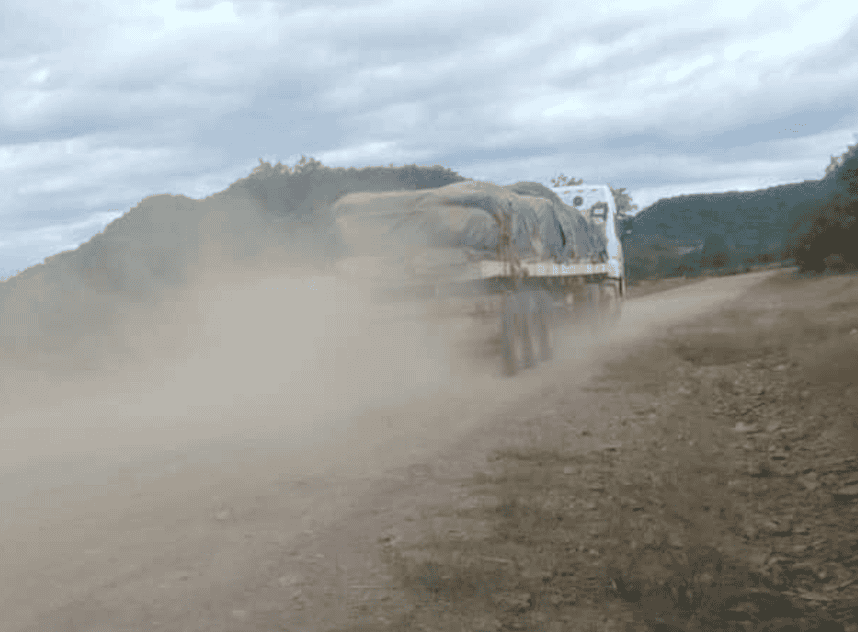
Heavy haulage trucks transporting raw lithium ore are actively destroying the region’s fragile public infrastructure. Rural gravel roads designed for light passenger traffic have disintegrated under the weight of multi-ton mining vehicles, frequently stranding public commuter buses and blanketing villages in dust columns.
Zimbabwe’s largely defunct national rail network leaves communities bearing the brunt of an unsustainable reliance on road transport.
Basic utilities are facing similar structural breaking points. While specific firms have invested in isolated infrastructure—such as last-mile power lines or localized coal-fired plants—these investments function as privatized utility islands that power machinery inside the gates while surrounding villages continue to suffer from chronic blackouts and depleted water boreholes.
Policy experts argue that breaking Zimbabwe’s resource curse requires an urgent shift from ad-hoc corporate social responsibility to legally binding, community-centered benefit-sharing mechanisms. Analysts suggest that the Mutapa Investment
Fund must be transparently deployed to rehabilitate shared public roads, water systems, and power grids rather than solely subsidizing energy-intensive refining operations.
With global green tech markets evolving rapidly, experts warn the window for structural course correction is narrowing, leaving frontline communities exposed to the long-term liabilities of an unmitigated extraction boom.


