


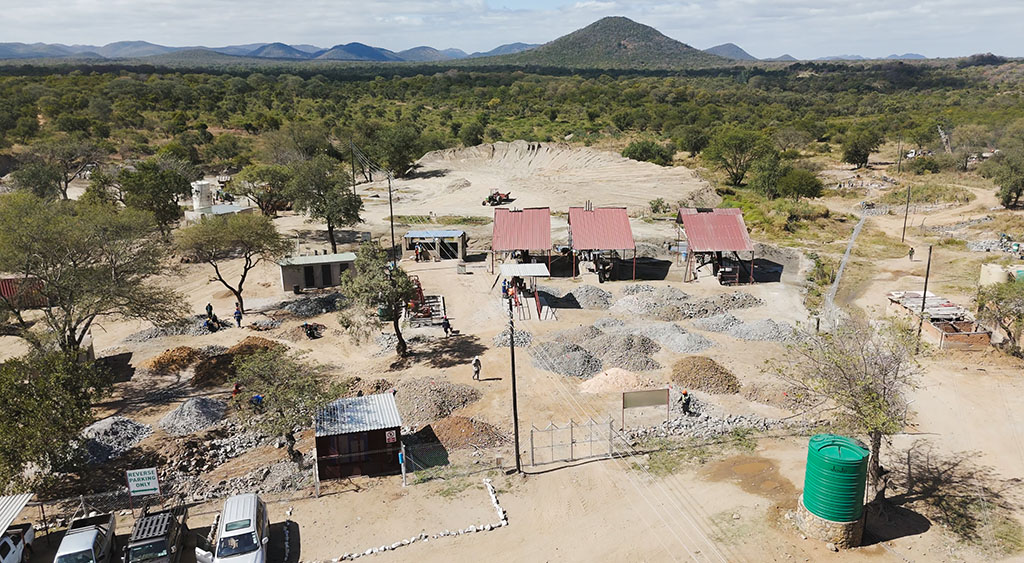

British miner Kavango Resources Plc said it has recorded strong metallurgical testwork results at its Hillside Gold Project in Zimbabwe, supporting plans for imminent commissioning of its processing plant and future production expansion.
The results form a key technical milestone for the project, confirming high gold recovery rates and processing parameters suitable for both near-term production at a 50 tonnes-per-day plant and longer-term scale-up to 250 tonnes per day.
Hillside, which comprises the Bills Luck, Steenbok, Britain, and Nightshift prospects, is Kavango’s most advanced and currently producing asset. The project covers 44 gold claims over 503 hectares.
The company said the completed metallurgical programme defines optimal processing conditions and reagent requirements needed to commission its 50 tonnes-per-day carbon-in-leach plant.
It also provides the basis for a planned expansion to a 250 tonnes-per-day facility.
Current production at Hillside averages about two kilogrammes of gold per month from selected mining zones.
Kavango interim chief executive officer Peter Wynter Bee said the results were “extremely encouraging” and confirmed that all processing parameters were within normal ranges, with no excess grinding or reagent consumption required.
“This gives us the confidence to continue building the resource base at our Hillside projects to increase production via future capacity expansions,” he said.
He added that the testwork would support optimisation of the 50 tonnes-per-day plant once operational, which he said was imminent.
Kavango thanked Solo Resources and Maelgwyn Mineral Services for completing the testwork programme.
The study showed gold recoveries of more than 95% under ideal laboratory conditions using blended Nightshift and Bill’s Luck ores.
It said real-world recoveries are expected to range between 90% and 93%.
The Nightshift sample indicated that 100% of the gold was native and non-refractory, while the Bill’s Luck sample showed 91% free-milling gold, including native gold and electrum.
The company said limited coarse gold was detected, and mineral species were very fine-grained.
It also identified low levels of carbonaceous material and other elements such as copper and zinc that could affect reagent consumption.
Variability testing indicated a target grind size of 75 microns for optimal recovery.
Gravity recovery using centrifugal concentrators ranged between 50% and 90%.
Gold concentrates can be further processed using intensive leach reactor technology, achieving up to 90% recovery within eight hours and up to 98% within 24 hours, the company said.
Reagent and energy consumption levels were described as within normal industry ranges.
Kavango operates two additional projects in Zimbabwe, the Nara Gold Project and the Leopard Gold Project.
The company plans to increase output to 250 tonnes per day at an average grade of 2,5 grammes per tonne, targeting annual production of 8 000 ounces by 2028. – (Newsday)


