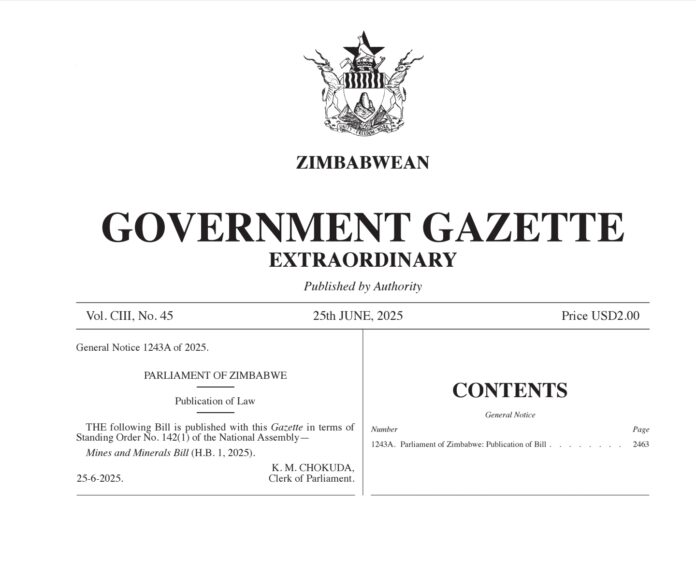

For more than six decades, Zimbabwe’s mining sector has operated under the Mines and Minerals Act [Chapter 21:05], a law that came into effect on 1 November 1961 and was originally designed for a vastly different mining industry.
As lawmakers debate the Mines and Minerals Bill 2025, the discussion has evolved beyond technical legal reforms into a broader question of whether the country’s mining legislation can keep pace with the transformation of one of its most important economic sectors.
Mining today bears little resemblance to the industry that existed when the law was enacted. In 1961, the sector was dominated by minerals such as gold, asbestos and chrome, with prospecting, surveying and claim administration largely dependent on paper records and manual processes. Today, Zimbabwe is positioning itself as a major producer of lithium and other critical minerals essential to the global energy transition, while large-scale projects in platinum, gold, iron and steel continue to attract significant investment. Yet much of the legal framework governing these activities remains rooted in an era before digital technology, modern environmental standards and contemporary mining finance.
The age of the legislation alone is not necessarily its biggest weakness. Successive governments have amended the Act numerous times and have introduced a series of regulations to keep parts of the framework relevant. Statutory instruments issued in 2016, 2020 and 2022 revised licensing fees, prospecting charges, inspection fees, ground rentals and special grant costs, replacing monetary figures that had become obsolete over time. These amendments helped modernise the administrative and financial aspects of mining regulation without fundamentally altering the architecture of the law.
However, many provisions that defined mining administration in the early 1960s remain embedded in the legislation. The Act still contains references to manual surveying techniques, including tape-and-compass surveys, paper plans submitted in triplicate and registered-letter notification procedures. It also prescribes traditional development work requirements based on shafts, tunnels and specific physical workings that were once standard methods of proving activity on a mining claim. While these provisions may have been suitable decades ago, critics argue that they fail to adequately recognise modern exploration methods such as remote sensing, drone technology, geophysical surveys, GIS mapping and digital geological modelling.
Perhaps the strongest argument for reform lies not in what the law contains, but in what it lacks. The Act was drafted long before concepts such as Environmental, Social and Governance (ESG) reporting, mine closure planning, community benefit-sharing agreements, biodiversity protection and climate-related obligations became central to mining governance worldwide. Although environmental information requirements were introduced through later amendments, mining policy specialists have continued to argue that the law does not provide a sufficiently comprehensive framework for managing the social and environmental impacts associated with modern mining operations.
Efforts to overhaul the legislation are not new. Reform discussions have been underway for years through various iterations of the Mines and Minerals Amendment Bill. Government, mining companies, small-scale miners, civil society organisations and legal experts have repeatedly engaged in consultations aimed at producing a modern mining code. However, progress has often been slowed by competing interests.
One of the most contentious issues has been security of tenure. Investors have consistently sought stronger legal protection for mining titles and greater certainty regarding the acquisition, transfer and retention of mining rights. At the same time, debate has persisted over ministerial discretion in the allocation and administration of mining rights, with some stakeholders advocating greater transparency and oversight mechanisms. Disagreements have also emerged around community participation, benefit-sharing arrangements and the balance between landowner rights and mineral rights. These competing priorities have complicated efforts to achieve consensus on comprehensive reform.
The adoption of Zimbabwe’s Constitution in 2013 added further momentum to calls for reform. Legal analysts and industry stakeholders argued that mining legislation needed to better reflect constitutional principles relating to environmental protection, accountability and natural resource governance. While some amendments followed, the comprehensive replacement of the Act remained elusive.
The Mines and Minerals Bill 2025 therefore arrives at a critical time. Zimbabwe’s mining industry is increasingly being shaped by lithium development, beneficiation initiatives, large-scale foreign investment and ambitions to become a significant player in global critical mineral supply chains. Supporters of reform argue that achieving those goals requires legislation that provides a modern digital cadastre system, stronger environmental safeguards, transparent licensing procedures, community development provisions and a clearer framework for strategic minerals.
Yet the challenge for lawmakers will be balancing modernization with continuity. While many stakeholders agree that the 1961 framework needs updating, there is also concern about preserving the legal certainty that has underpinned mining rights for decades. The outcome of the Bill’s parliamentary debate could therefore determine whether Zimbabwe continues to rely on an amended colonial-era framework or finally adopts a mining law designed for the demands of the twenty-first century.
For a sector expected to drive economic growth, export earnings and industrial development, the stakes extend far beyond legislative drafting. The debate is ultimately about how Zimbabwe intends to govern its mineral wealth in an increasingly competitive global mining landscape.