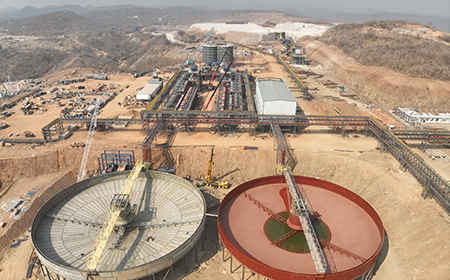

Namib Minerals has reported a sharp increase in production at its How Mine operation in Zimbabwe following the successful commissioning of an expanded milling plant that is already delivering higher throughput and improved operating efficiencies.
The Nasdaq-listed gold producer said the expanded mill, commissioned ahead of schedule in October, has achieved an availability rate of approximately 94.6% during its initial operating phase, allowing the mine to process significantly more ore than in previous months.
During October 2026, How Mine milled 52,376 tonnes of ore, representing a 27.3% increase from the third-quarter monthly average of 41,143 tonnes. Gold production rose to 2,396 ounces, up 21% from the third-quarter monthly average of 1,981 ounces.
Namib Minerals Chief Executive Officer Tulani Sikwila said the results demonstrate that the additional milling capacity is translating into stronger operational performance and improved economics.
“With the Expanded Mill now commissioned, October gives us the first clear evidence that the additional capacity has translated into more tonnes, more ounces and lower unit costs, which we expect to support stronger cash generation,” he said.
According to the company, throughput increased to 97.3% in October compared to 76.5% during the third quarter, reinforcing management’s view that milling capacity had been the primary bottleneck limiting production at the mine.
The production gains were achieved despite a decline in average ore grade to 1.64 grams per tonne from 1.72 grams per tonne recorded during the third quarter. Metallurgical recovery improved marginally from 86.3% to 86.7%, helping offset the impact of lower grades.
Management said the expanded mill’s performance confirms that increased processing capacity can compensate for grade variability while supporting higher gold output.
The stronger production performance also contributed to lower operating costs. Namib Minerals reported October C1 cash costs of US$1,155 per ounce and all-in sustaining costs (AISC) of US$1,783 per ounce.
The company expects further cost reductions once planned power infrastructure upgrades are completed during the first quarter of 2027. Management estimates that access to lower-cost grid power could reduce C1 cash costs to approximately US$1,067 per ounce and AISC to around US$1,695 per ounce, although these figures are not formal guidance.
Sikwila said sustained performance at How Mine would provide the financial platform required to support the company’s broader growth plans.
“How Mine is the operating and financial foundation of Namib Minerals. We believe sustained performance at How Mine strengthens the platform from which we intend to advance Redwing and the wider growth strategy,” he said.
The latest results mark an important milestone for How Mine, with Namib Minerals viewing the successful ramp-up of the expanded mill as a key step toward increasing production, improving margins and supporting future expansion projects across its Zimbabwean gold portfolio.