


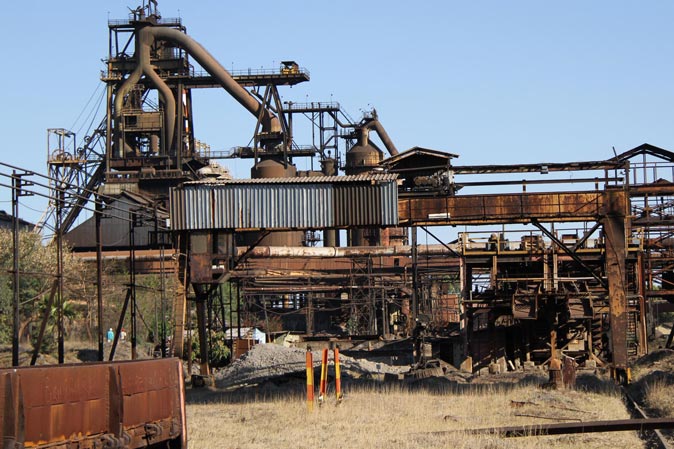

Parliament’s Public Accounts Committee (PAC) chairperson, Caston Matewu, says the Zimbabwe Iron and Steel Company (Ziscosteel) is effectively a “dead asset”, arguing that policymakers should abandon efforts to revive the once-iconic steel maker and instead focus on alternative uses of its remaining resources.
During a fact-finding mission by the committee, Matewu said further capital injections into Ziscosteel would not yield meaningful returns, urging a fundamental rethink of how the entity’s assets—including limestone deposits—could be repurposed.
“I don’t think Ziscosteel can be resuscitated, and part of our report, which shall be tabled before the House, will seek to explore what the Mutapa Investment Fund can do with the steel giant,” he said.
“We don’t think the current structure can work because the machinery is rusty and archaic. To think it can be resuscitated is misleading. The proper way to describe it is that Ziscosteel is dead.”
Matewu added that the Mutapa Investment Fund should consider alternative commercial pathways for the firm’s remaining resource base, particularly limestone, amid rising competition from new entrants such as Dinson Iron and Steel Company in Manhize.
“Mutapa should think outside the box to determine what else can be done with the limestone resources because there is now competition from Dinson Iron and Steel Company in Manhize. I don’t think it would be wise for Mutapa to continue investing in the current structure,” he said.
Mutapa Investment Fund deputy chief investment officer Ernest Denhere acknowledged the scale of the challenge facing the State after the entity was placed under its management, saying options for Ziscosteel’s future are still under review.
“We are still looking at all available options, bearing in mind that the entity only recently came under Mutapa,” he said.
“It is a mammoth task, but hopefully we will be able to unpack it in a productive and sustainable way.”
Denhere also told legislators that Mutapa Gold Resources is pursuing an ambitious expansion programme aimed at nearly doubling gold output within three years, underscoring the growing strategic importance of bullion revenues in stabilising the economy and funding industrial recovery efforts.
He said production is targeted to rise from about 300 kilogrammes per month to 570 kilogrammes by 2028, driven by mine expansion, exploration and capital investment.
“Over the next five years, Mutapa Gold Resources aims to build a resilient, competitive and sustainable gold business that delivers measurable national impact,” Denhere said, situating the plan within the National Development Strategy 2 (NDS2), the government’s blueprint for industrialisation and export-led growth.
He revealed that more than US$12 million has been allocated to exploration in 2026 alone, with the goal of securing a minimum 10-year life-of-mine across operations.
Current reserve estimates indicate that Freda Rebecca Gold Mine has about four years of mine life remaining at present extraction rates, compared to approximately six years at Jena Mines and 15 years at Shamva Gold Mine.
“Beneficiation and value addition are central to our strategy,” Denhere said.
“Mutapa Gold Resources is committed to moving up the value chain by strengthening local processing, refining and downstream linkages.” – (Business Times)


